
Table of Contents
Quick answer: Is Paris safe to visit?
Paris is visitable for most travelers, but risk is not uniform across the city or across the day. Crowded tourist areas and public transport require more attention to belongings, while late-night plans should be matched to the neighborhood, the route and your accommodation. The figures below are context, not a personal risk score: check the source and date before using them to choose where to stay.
Quick answer: A Paris crime map is a relative signal, not a live guarantee of safety. Check the source and date, then use it with daylight access, transit connections and your own evening route when choosing where to stay.
Paris crime map: what it can and cannot tell you
The French Ministry of the Interior’s SSMSI provides an official interactive map of recorded-crime statistics and an overview of the data. It presents annual police- and gendarmerie-recorded indicators, available from 2016, at commune and department levels, based on where offences were recorded. Check the year, indicator, unit and geographic level before comparing places; categories do not always count the same things, and this is not a live incident feed.
These statistics cannot estimate your personal risk at a particular street, hotel or time. Paris arrondissement data are available only for specific indicators, including drug use and trafficking; they do not form a complete borough-by-borough safety ranking. Treat missing categories as unavailable, not as zero, and use current local guidance alongside your accommodation, transport and route home.
Archived Paris area maps
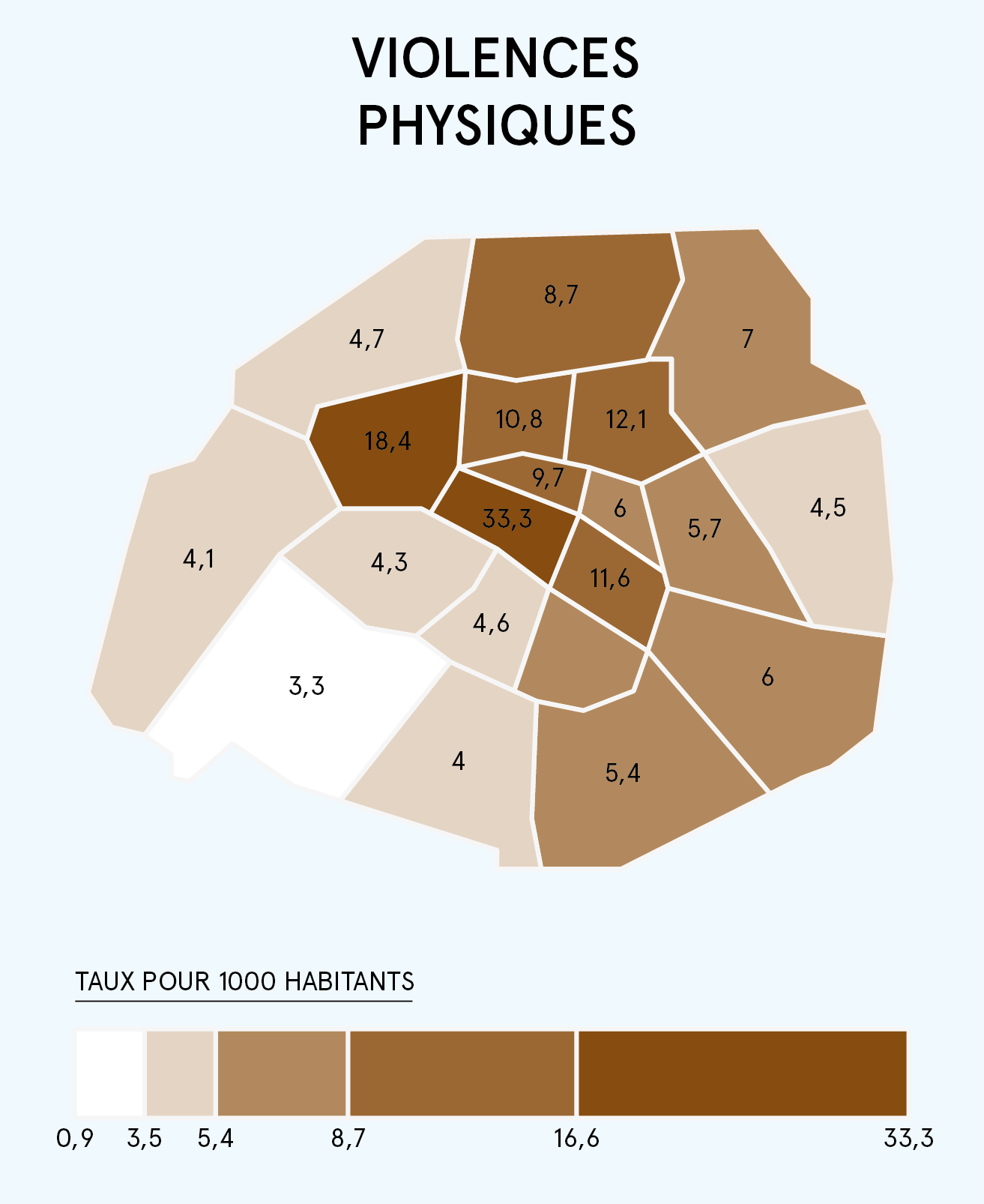
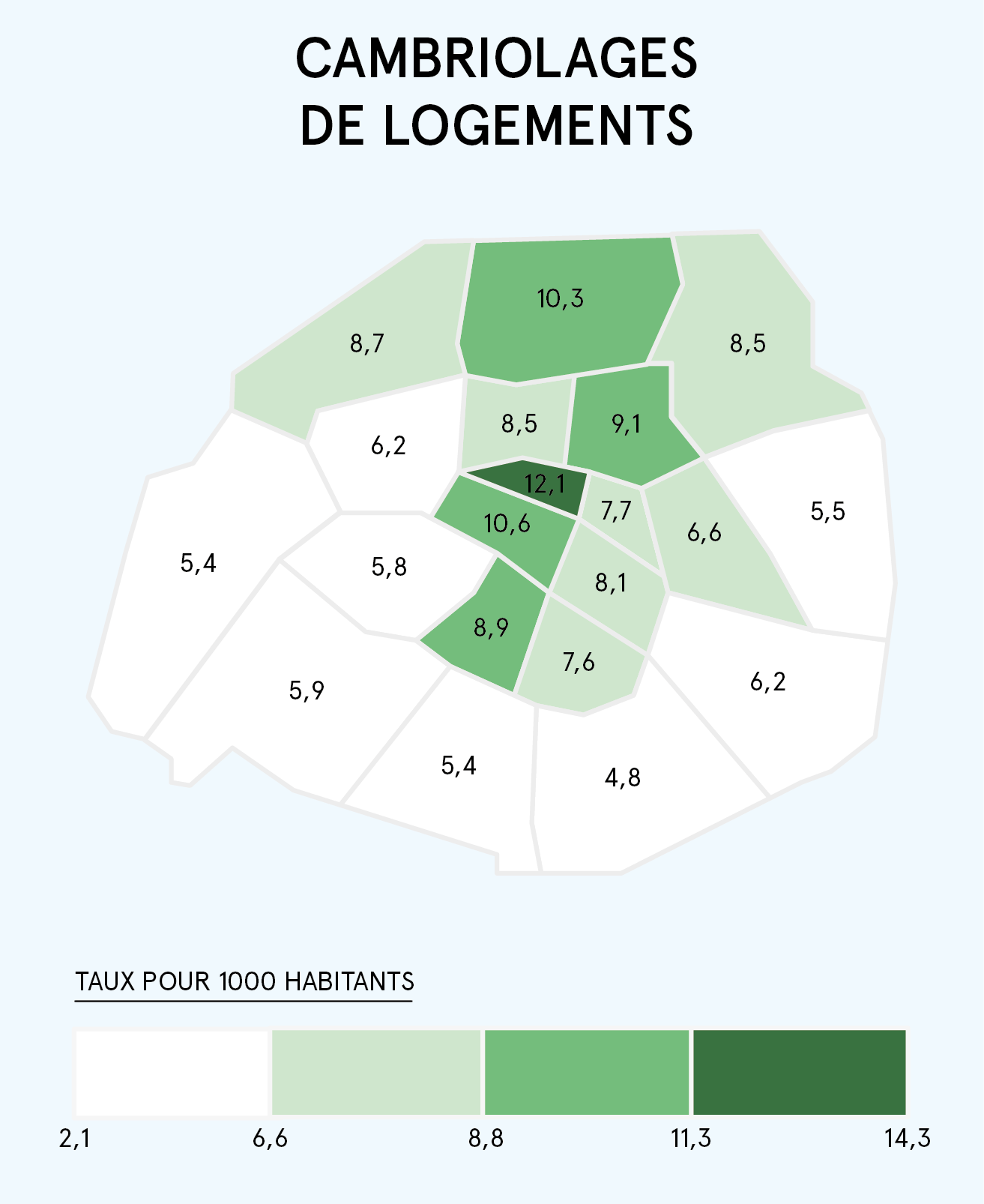
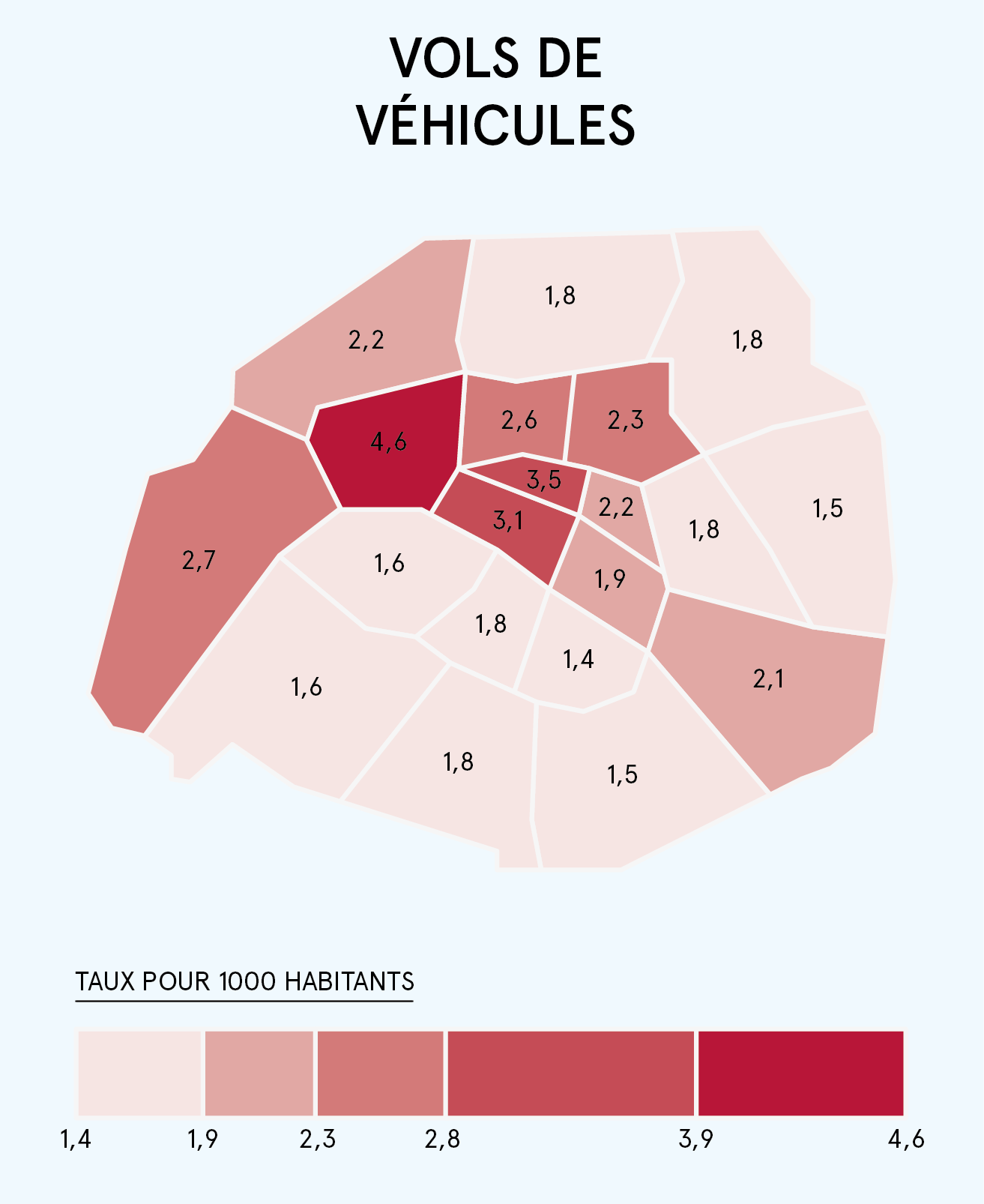
These four graphics appeared in the earlier version of this guide and their original image URLs remain online. The archive identifies the files as uploaded in March 2018, but the underlying data year, definitions and methods could not be re-verified. They are retained here as historical reference only—not as current official statistics, a complete safety ranking or advice on where to stay. For current recorded-crime data, use the official SSMSI sources above.
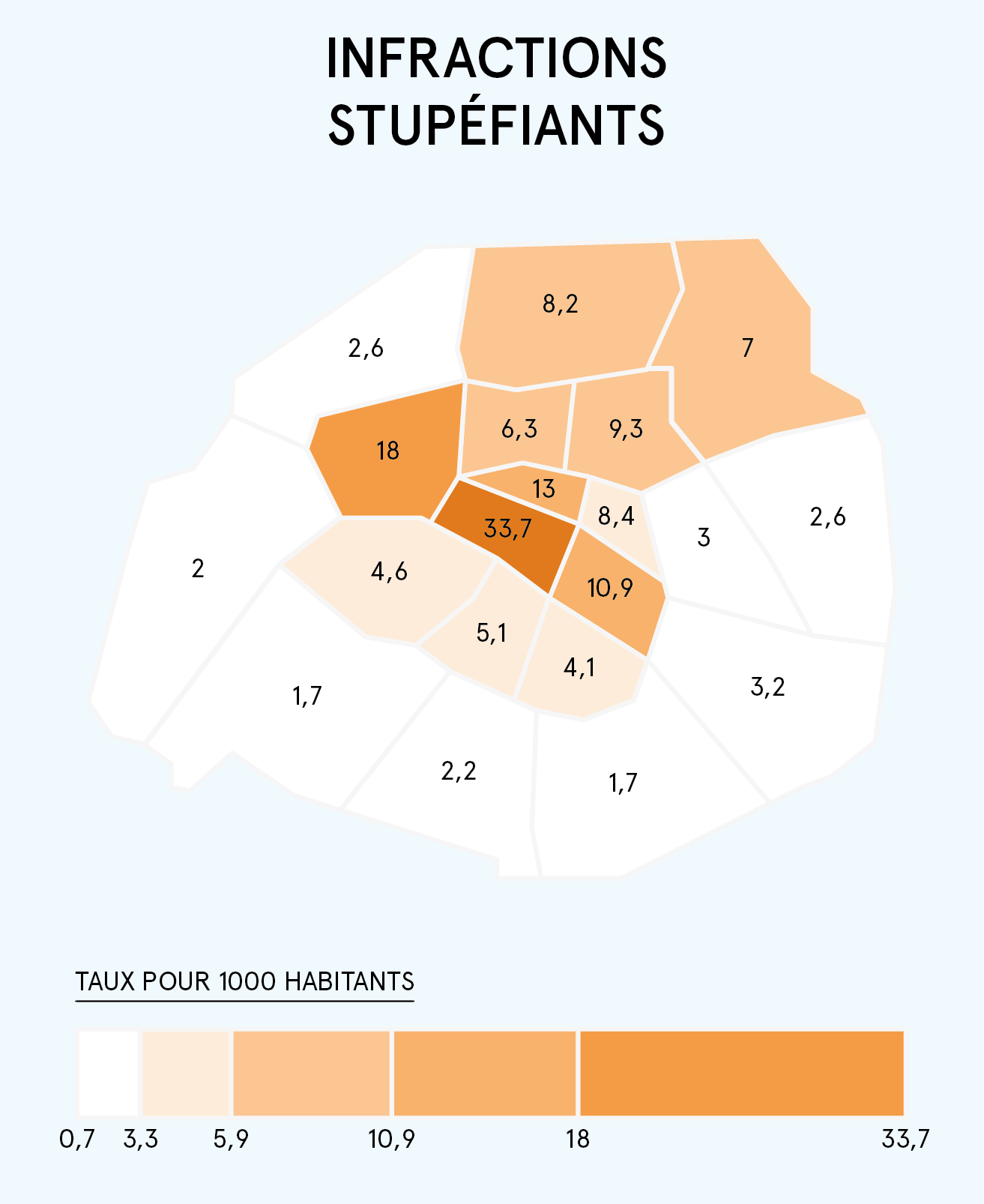
Which areas are practical for a safer stay?
Start with a well-connected base that is easy to reach after dark, then confirm the latest local guidance and your route home. Keep the published source and Last checked date beside any number you use.
What’s the crime rate in Paris?
2025 recorded-crime figure: Linternaute reports a rate of 109.58 recorded crimes and offences per 1,000 Paris residents (230,527 entries for a reported population of 2,103,778). This is Linternaute’s published headline rate, not one standardized all-offence measure from the Interior Ministry and not a visitor’s personal chance of being a crime victim. See Linternaute’s Paris breakdown and methodology; the counting-unit caveat is explained below.
The French Interior Ministry’s 2025 commune-level release lists 14 recorded-offence indicators and includes Paris arrondissements among its covered geographies; data availability varies by category. SSMSI documentation explains that indicators can count different things, such as victims, alleged offenders or vehicles, so unlike units should not be added together. Paris-arrondissement data cover only specific indicators, including drug use and trafficking—not a complete all-crime borough ranking. These are recorded annual indicators, not a live incident feed or an estimate of an individual visitor’s risk. See the official 2025 release and SSMSI dataset documentation.
The Crime and Safety Index values and detailed scores below are Numbeo visitor-perception measures, not police-recorded rates. Numbeo says its website-visitor survey responses are scaled from −2 to +2 onto a 0–100 scale, and its current index uses data from the previous five years. BonAdvisor’s values are a dated snapshot last updated 11 September 2026; check Numbeo’s live Paris page for current values and its update date, and Numbeo’s methodology for how the index is built. These scores describe submitted perceptions, not an individual traveler’s probability of experiencing crime.
| Crime Index: | 57.95 |
| Safety Index: | 42.05 |
Numbeo crime-perception scores
| Level of crime | 62.32 | High |
| Crime increasing in the past 5 years | 73.34 | High |
| Worries home broken and things stolen | 52.33 | Moderate |
| Worries being mugged or robbed | 60.67 | High |
| Worries car stolen | 47.19 | Moderate |
| Worries things from car stolen | 57 | Moderate |
| Worries attacked | 58.87 | Moderate |
| Worries being insulted | 64.33 | High |
| Worries being subject to a physical attack because of your skin color, ethnic origin, gender or religion | 48.94 | Moderate |
| Problem people using or dealing drugs | 64.77 | High |
| Problem property crimes such as vandalism and theft | 67.92 | High |
| Problem violent crimes such as assault and armed robbery | 56.63 | Moderate |
| Problem corruption and bribery | 44.82 | Moderate |
Numbeo safety-perception scores
| Safety walking alone during daylight | 62.91 | High |
| Safety walking alone during night | 35.77 | Low |
Last update: 11 September 2026
These data are based on perceptions of visitors of this website in the past 5 years.
If the value is 0, it means it is perceived as very low, and if the value is 100, it means it is perceived as very high.
Paris areas and accommodation: practical trade-offs, not a safety ranking
The areas below are examples for comparing location and visitor amenities—not a ranking of the safest neighborhoods. The recorded-crime data on this page do not estimate risk at a particular hotel or street, and the official arrondissement data cover only selected indicators. Compare the exact address, the route and transit you expect to use after dark, and current local guidance. Paris visitor guidance warns that busy tourist areas can attract pickpockets; keep belongings secure in crowded places. Read the current Paris visitor safety advice.
1. Marais
The trendiest neighborhood in Paris, the Marais is defined by the hip Parisians who come to eat, drink, and shop in this uber cool quartier.
Though the tone of the neighborhood slants towards a younger set, the Marais’s diversity offers something for everyone – from its famed Jewish quarter to the historic Place des Vosges – for visitors who’ve checked off their sightseeing list, the Marais is the perfect place to understand Paris outside of the guidebooks.
- Best Hotel: Le Pavillon de la Reine & Spa
- Best Cheap/Midrange Hotels: Hôtel Marais Bastille • France Louvre
2. Saint Germain
Saint Germain retains the timeless charm of the Left Bank while buzzing with a lively array of galleries, restaurants, and jazz clubs. From the upscale shops that dot the bustling Boulevard Saint Germain to the aristocratic calm of the Jardin du Luxembourg, this quarter is popular with locals and tourists.
This neighborhood typically attracts a well-heeled crowd who come seeking only the biggest names in food and fashion. Though at times the area may feel overrun with tourists, the biggest advantage is that you’ll find many shops and restaurants open in summer while other areas of the city are quiet.
- Best Hotels: Relais Christine • L’Hotel
- Best Cheap/Midrange Hotels: Holiday Inn Notre Dame • Welcome Hotel
3. Latin Quarter
The Latin Quarter is great for those who want a central location with classic Parisian charm while seeking something a little quieter.
Find somewhere away from the student hangouts for which the area is typically associated with and you’ll find yourself strolling down cobblestone streets, through leafy squares, and taking in some of the most diverse architecture in the city which includes Roman ruins, gothic spires, and the innovative Institut du Monde Arabe.
Great restaurants and wine bars abound in this part of the city as well as the lively market street Rue Mouffetard.
- Best Hotel: Hotel Parc Saint Severin
- Best Cheap/Midrange Hotels: Hôtel Les Dames du Panthéon • Grand Hotel Saint Michel • Hotel du College de France
4. The 7th
The 7th has everything you think of when you think of Paris – the Eifel Tower, the Seine, excellent museums, breathtaking architecture, charming markets, high-end shopping, and world-class restaurants.
Its diversity and versatility make it a popular choice for everyone, whether you’re looking for a romantic getaway or a family vacation. Visit the family-friendly Berges de Seines and you’ll have a riverfront play area that stretches from the Musee D’Orsay to the Pont D’Alma.
Or at night, take a romantic stroll near the Pont Alexander III bridge, one of the most beautiful Beaux-Arts bridges in Paris where you’ll also have a view of the Grand Palais just on the other side of the Seine.
Be sure to explore Rue Cler, a charming market street that has a village-like feel and gives you a small slice of Parisian life.
- Best Hotel: Le Cinq Codet
- Best Cheap/Midrange Hotels: Cler Hotel • Hôtel du Champ de Mars • Hotel Duquesne Eiffel
5. South Pigalle
Tourists who want a local Paris vibe should stay in South Pigalle. Just south of the former red light district, the city’s most up-and-coming destination offers quiet tree-lined streets dotted with fashionable boutiques, cafes, and a thriving restaurant and bar scene.
A few tucked away boutique hotels have popped up in recent years, allowing tourists to take advantage of its proximity to the hills of Montmartre and nearby Sacre Coeur.
- Best Hotel: Maison Souquet
- Best Cheap/Midrange Hotels: Hotel Saint-Louis Pigalle • Grand Pigalle Hotel
6. Montmartre
Montmartre’s charm and breathtaking views are the biggest reasons to stay in this part of Paris. Though it’s a bit far from the other main attractions, you can easily reach the rest of the city by metro or explore this neighborhood’s unique history.
Away from the touristy spots such as the Sacre Couer, Moulin Rouge, and Place du Tertre, you’ll find quiet cobblestone streets to wander with Avenue Junot having some of the most beautiful houses in Paris or Rue des Saules which climbs past the Vigne de Montmartre (Paris’s only vineyard).
The street also connects the Montmartre hilltop with the Lamarck-Caulaincourt neighborhood with several stretches of stairs and its beauty was immortalized by artists such as Cezanne and Van Gogh.
- Best Hotel: Le Relais Montmartre
- Best Cheap/Midrange Hotel: Best Western Plus Hôtel Littéraire Marcel Aymé • ibis Montmartre 18ème
7. The 1st
The 1st arrondissement is a great base for sightseeing.
You’re in the heart of Paris with many of the city’s sights within walking distance such as the Louvre, Tuileries Garden, and Notre Dame Cathedral while the Musee D’Orsay and Saint Germain are just across the river.
Combined with a fantastic dining scene including some of Paris’s best restaurants like Spring and Verjus, visitors have an abundance of activities to choose from both day and night.
- Best Hotels: Mandarin Oriental • Le Meurice
- Best Midrange Hotels: Hôtel Regina Louvre • Hôtel Paris Louvre Opéra
Where Should I Stay In Paris?
The rooftop bar at the Hotel des Grands Boulevards.
Still confused?
That’s my fault. Here are 3 great reasonably priced hotels. You can’t go wrong with any of these places.
- Hotel des Grands Boulevards – Fantastic 4-star hotel that is 30 seconds from a metro station and walking distance to the Louvre, Notre Dame, and both the Gare du Nord (direct trains to the airport) and Gare de l’Est train stations.
- Cler Hotel – Great 3-star hotel located in one of the most charming neighborhoods in Paris. Surrounded by local shops, cafes, and restaurants. Walking distance to the Eiffel Tower.
- Gardette Hotel in Paris – My favorite midrange hotel for families. Nice location in a non-touristy Paris neighborhood (bus still fairly close to the main attractions). Across the street is a nice square and grean area with a kids playground. Several great local restaurants are steps from the hotel’s front door. It’s an easy walk to the Marais and several metro stations.


